
Industry insights
Why Your Field Team is Driving in Circles
25 June 2026

Written By Nikolaj Gaba
Share to
About the study
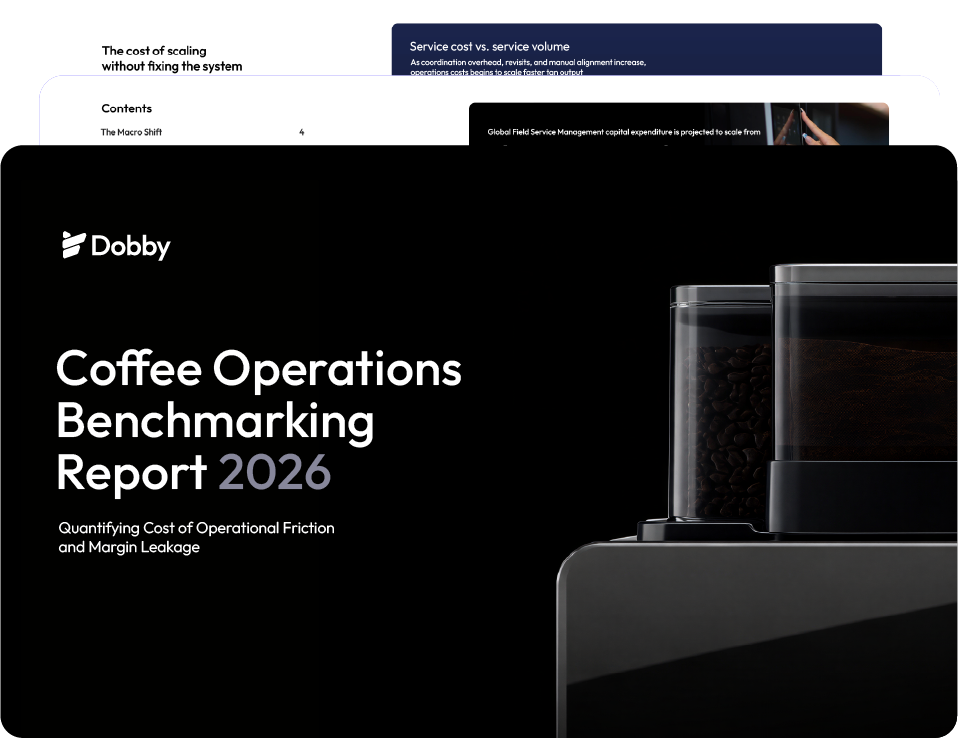
This article highlights critical data segments from the 2026 Coffee Operations Benchmarking Report, an industry-wide analysis mapping dispatch inefficiencies, secondary truck rolls, and fleet margin reclamation.
Every commercial coffee service business with an expanding regional footprint hits a point where logistical efficiency begins to decay.
In the early days, routing and dispatch are straightforward. A technician gets an urgent call, packs their van, handles the fix, and heads back. But as you scale past critical capacity thresholds managing hundreds of bean-to-cup machines and traditional espresso systems across disjointed corporate accounts routing ceases to be a simple driving challenge.
It becomes an architecture problem.
If your field operations rely on static scheduling and siloed tools, your vans aren’t just navigating traffic. They are driving in circles. Data from the 2026 Coffee Operations Benchmarking Report reveals the true structural costs of blind dispatching and logistical fragmentation.
The 24% Second-Visit Friction Point
According to recent benchmarking data, 4% of all commercial coffee service dispatches require a secondary site visit. Nearly one out of every four dispatches fails to achieve a first-time fix.
This structural inefficiency doesn’t happen because technicians lack technical skill or mechanical experience. It happens because they lack localized context before they put the keys in the ignition.The $280 Micro-Leak per Truck Roll
A secondary site visit is never just a minor scheduling inconvenience; it is an explicit cash drain. The benchmark report indicates that the average cost of an unnecessary secondary truck roll sits at $280+ per incident. When you multiply that $280 figure across dozens of technicians tracking across a major metropolitan area every month, a quiet financial drain forms:
Contractual Revenue Erosion: Missed Service Level Agreements (SLAs) trigger financial penalties and fracture long-term corporate account retention.
Blind Routing vs. Dynamic Field Architecture
Many operators attempt to solve routing friction by adding more human dispatch coordinators or implementing tougher scheduling rules. But forcing more administrative overhead onto a broken workflow doesn’t fix the underlying disconnect.
By natively pairing intelligent, automated route planning with real-time van stock tracking and complete asset histories, field teams gain absolute situational clarity before they ever leave the warehouse. A technician knows exactly what machine breakdown they are walking into, which spare part is required, and exactly where that component is located inside their vehicle.
Eliminating field friction isn’t about pushing your team to drive faster. It’s about ensuring that every single dispatch counts.
The Reality of Scaling the Vortex
When an operation adds new commercial accounts and deploys more equipment, the volume of manual touchpoints grows exponentially, not linearly. A dispatch and coordination workflow built on app-hopping simply cannot scale. It requires adding more human administrative hours just to keep the business from dropping critical machine data, missing SLA deadlines, or letting unbilled spare parts slip through the cracks.
Eliminating the chaos of daily dispatch isn’t a matter of push-notification urgency or tougher scheduling rules. It requires replacing a fragmented software stack with a unified core operational layer where scheduling, machine asset data, and inventory live in absolute synchronization.
Stop the margin leakage
See the Logistical Blindspots Costing Your Fleet $280+ Per Truck Roll