


Most coffee operators and their customers know that at some point their coffee machine might break or require service.
It is what happens after the machine breaks that impacts your business and customer relationship. When a client calls you about a broken machine, they expect fast action, clear communication, and a solution that lasts.
That’s where Service Level Agreements (SLAs) come in.
They set the standards that define how quickly you respond, how soon you resolve, and how transparently you communicate.
But many coffee operators struggle to manage SLAs effectively. While they set targets, tracking information across spreadsheets, inboxes, and manual reports quickly becomes a nightmare. Teams only realise they’ve missed their SLAs when the client is already unhappy.
In this blog, we’ll highlight how operators can simplify SLA tracking, make compliance easier, and use clear data to manage service performance with less manual work.
What is SLA adherence?
As a coffee or vending service provider, an SLA is an agreement between you and your customers that highlights the services you will deliver, the responsiveness that can be expected, and how you will measure performance.
SLA adherence measures how well your team meets the agreed service targets. Each type of SLA plays a different role in shaping the customer experience:
Response SLAs track how long it takes your team to acknowledge or start working on a ticket after it’s logged.
Resolution SLAs measure how quickly the issue is fully resolved.
Communication SLAs ensure your customers receive regular, transparent updates throughout the process.
4 common reasons SLA tracking fails in service operations
Manual data collection:
When SLA data lives across spreadsheets, email threads, and whiteboards, updates become inconsistent and are often outdated. Managers in your team spend hours compiling reports instead of improving operations.
No link between scheduling:
If your SLA timelines are not connected to technician schedules, your entire process turns manual and inefficient. Dispatchers might not even realise a ticket is overdue until it’s too late, leading to last‑minute rescheduling, missed SLAs, and frustrated customers. For example, when a technician gets stuck on an unexpected repair, no one else is assigned to cover their next appointment, pushing the ticket beyond its SLA window and creating a domino effect across the service day.
Fragmented systems:
This is in line with the manual data collection point we discussed above. Sales, service, and back-office teams often work in different manual systems. A ticket closed in one tool or spreadsheet may not update in another, leading to inaccurate SLA reports and poor visibility.
Lack of visibility:
All of these things create an overall lack of visibility within the company. For many coffee operators, SLA performance is only reviewed monthly. By then, any breach has already damaged customer trust, and the opportunity to fix it in real time is lost.
Consider this: A service manager on your team discovered during a monthly review that 20% of jobs had missed their SLA targets. Technicians completed the work, but there was no system in place to track when each task started or finished. Some tickets stayed open for days because completion updates weren’t logged. As a result, the manager didn’t know which jobs were still pending until the monthly report came out.
If they had real-time visibility into what was happening, all of this could be avoided.
That’s where a structured SLA tracking model can help coffee operators.
How to build a simple SLA tracking model for coffee operators?
Define measurable SLAs
Start by setting a baseline. Look at your current SLAs and how you’re performing against them.
Then, start by setting realistic response and resolution targets for each contract type.
Not every client or machine requires the same urgency. Segment your SLAs based on business impact and geography. For example, premium clients might have a 4-hour response time, while standard contracts could be 8 hours. What matters is that every target is measurable within your company.
Automate data capture
Manual logging is where most SLA systems break down. To avoid this, every service ticket should be automatically timestamped from creation to closure. This ensures that every action, job updates, technician notes, and part replacements are captured in real time and linked to its SLA target.
When timestamps are recorded automatically, managers can clearly see how each job is progressing, which tasks are falling behind, and where process improvements are needed.
To continue with the example we mentioned above, if the manager is able to see an SLA slipping for a job, they can rectify it in real-time, as compared to waiting till the end of the month to see 20% of jobs have missed their SLA targets.
Monitor live compliance
Some CRMs for coffee operators like Dobby have live dashboards, which make SLA tracking clear and easy to follow. The real-time views show which tickets are nearing their deadlines, which technicians have the highest workloads, and which customers are waiting for updates. This helps managers act quickly, assign jobs evenly, and prevent service delays.
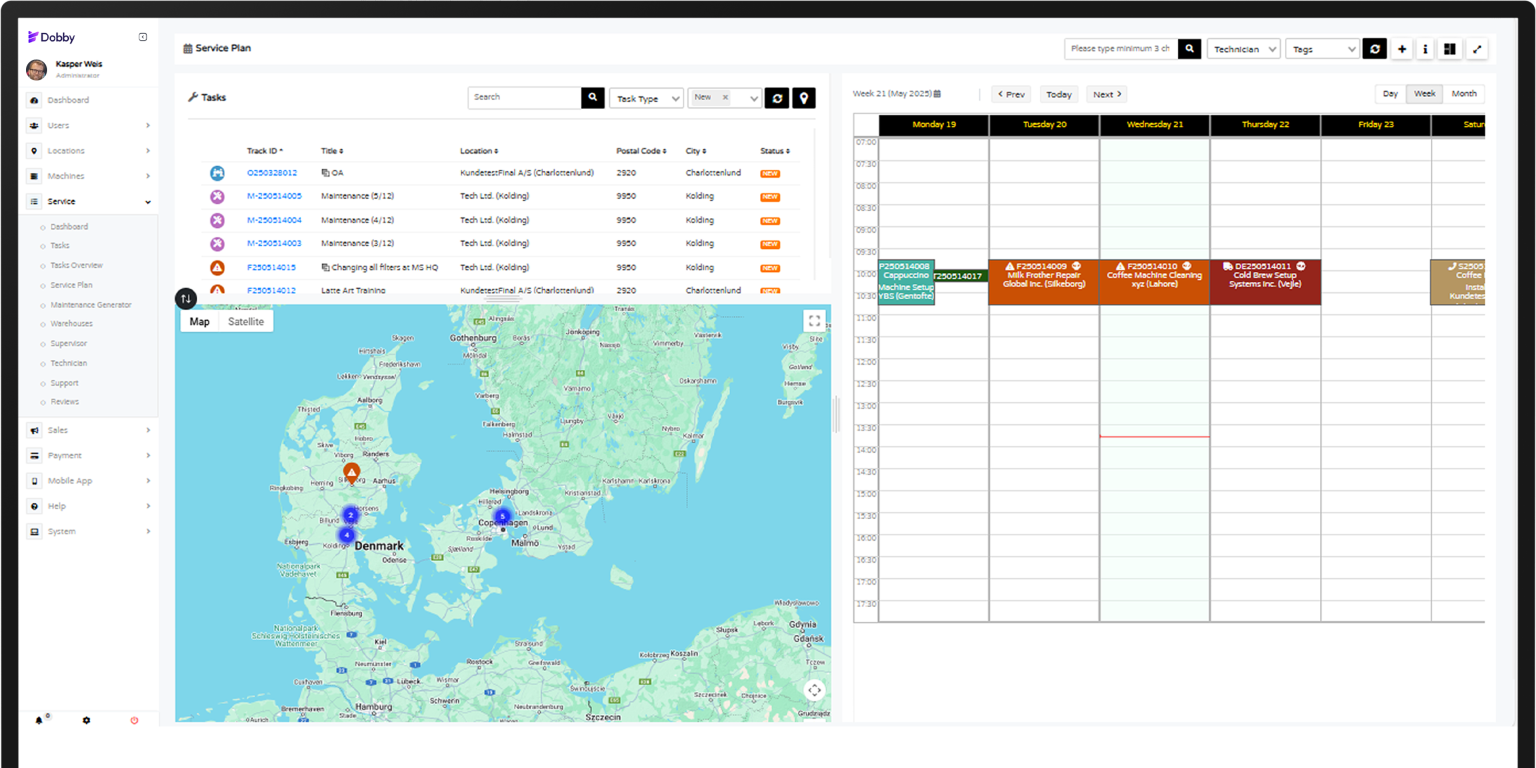
By combining these steps, SLA tracking becomes part of your daily operations. Managers then don’t need to take out hours every week just to keep track of them.
Here’s how this plays out: A service manager in your team might check the dashboard mid‑morning, see that two tickets in the city center are close to breaching, and assign a nearby technician who just finished another job. The system updates automatically, the customer receives an estimated arrival time, and the job is completed within the agreed window.
Now that we have the model in place, the next question is what to measure when it comes to SLAs.
5 key SLA metrics every coffee operator should track
To measure progress effectively, service managers need to focus on a few clear metrics. These KPIs help track where time is spent, how quickly issues are handled, and how well the team meets its commitments.
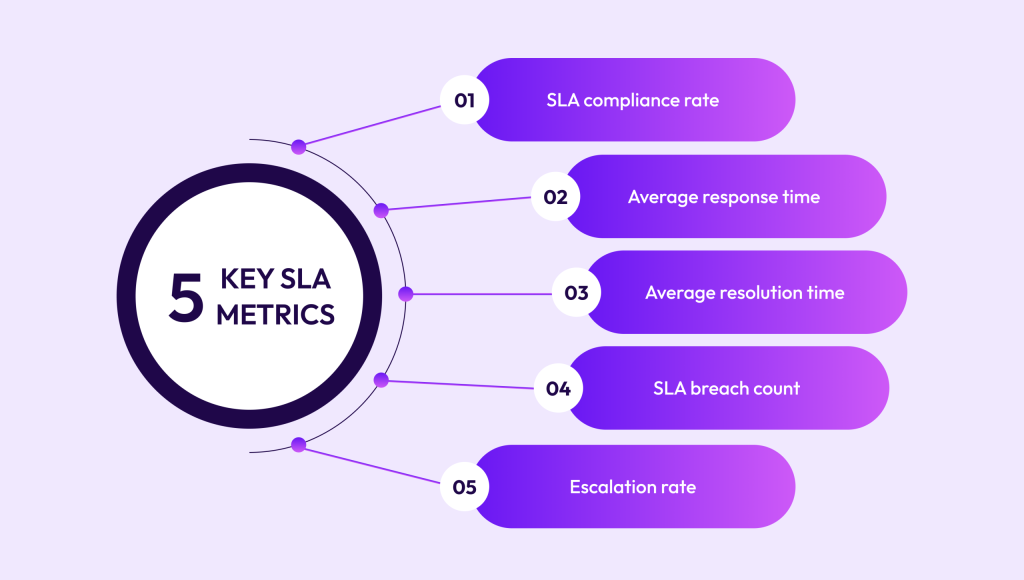
SLA compliance rate:
This is the percentage of tickets resolved within the agreed SLA time. This shows overall reliability and helps identify which contracts or regions need attention. It is calculated by dividing the number of tickets that met their SLA target by the total eligible tickets and multiplying that by 100.
Average response time:
The time between ticket creation and technician acknowledgment. It's a key indicator of how efficiently your dispatch and communication workflows run.
Average resolution time:
It shows how long it takes to close tickets from start to finish. Longer resolution times often point to recurring issues with parts, training, or workflow bottlenecks.
SLA breach count:
Tracking breaches by region, technician, or contract type helps uncover the specific causes behind missed SLAs. Reviewing this level of detail can help your managers make informed decisions, such as redistributing workload, adjusting targets, or planning additional training to close performance gaps.
Escalation rate:
This is the percentage of tickets that miss one SLA and trigger another. This metric highlights recurring breakdowns in process or communication.
Tracking these metrics consistently gives you the clarity to plan. Over time, this data becomes the foundation for better scheduling, improved technician allocation, and higher service predictability. Read to know more.
The next step: Turning SLA insights into operational improvement
Getting data is only one part of the equation. The next step is to use those insights to improve your daily operations. Data exposes inefficiencies that are often hidden day-to-day, like dispatch bottlenecks, poor inventory planning
or technicians overloaded with reactive jobs.
For instance, if most SLA breaches occur in one region, it may signal an unbalanced workload. Or if resolution times are rising, it could indicate recurring equipment issues or missing spare parts. With these insights, managers can adjust scheduling, training, or stock distribution before problems escalate.
But how do you get those insights?
Most service managers spend hours pulling data from spreadsheets, emails, and disconnected dashboards just to find out how their teams are performing.
That’s time that could be used to plan, coach, and improve. Read on to see how Dobby provides all of this in one place, so managers can focus on the analysis that drives better performance.
How Dobby supports SLA tracking and continuous improvement
SLA management becomes effortless when it’s built into your operations system. Dobby, the number #1 CRM for coffee operators, does exactly that. It embeds SLA tracking directly into your workflows so every ticket, technician, and customer update is monitored automatically.
Here’s how it works:
Automated timestamps on all tickets from creation to completion give an accurate record without manual input.
Live SLA dashboards highlight ongoing performance so managers can see risk areas at a glance.
Alerts for at-risk jobs notify your team before a breach occurs, allowing proactive action.
Detailed SLA reports break down compliance by technician, customer, or contract type to identify patterns and trends.
When SLA tracking is transparent, live, and automated, your teams stay accountable without micromanagement. Managers gain confidence in their numbers, technicians know their targets, and customers see the reliability they were promised.
Dobby gives coffee and vending operators the tools to make SLA tracking simple, automated, and impactful. Teams using Dobby see up to 43% reduction in their SLA times.
Book a call with our experts to see how Dobby can help you improve your SLA adherence.