
Industry insights
Beyond the Spreadsheet: Real-time Asset Visibility
30 July 2026

Written By Daniel Møller
Share to
About the study
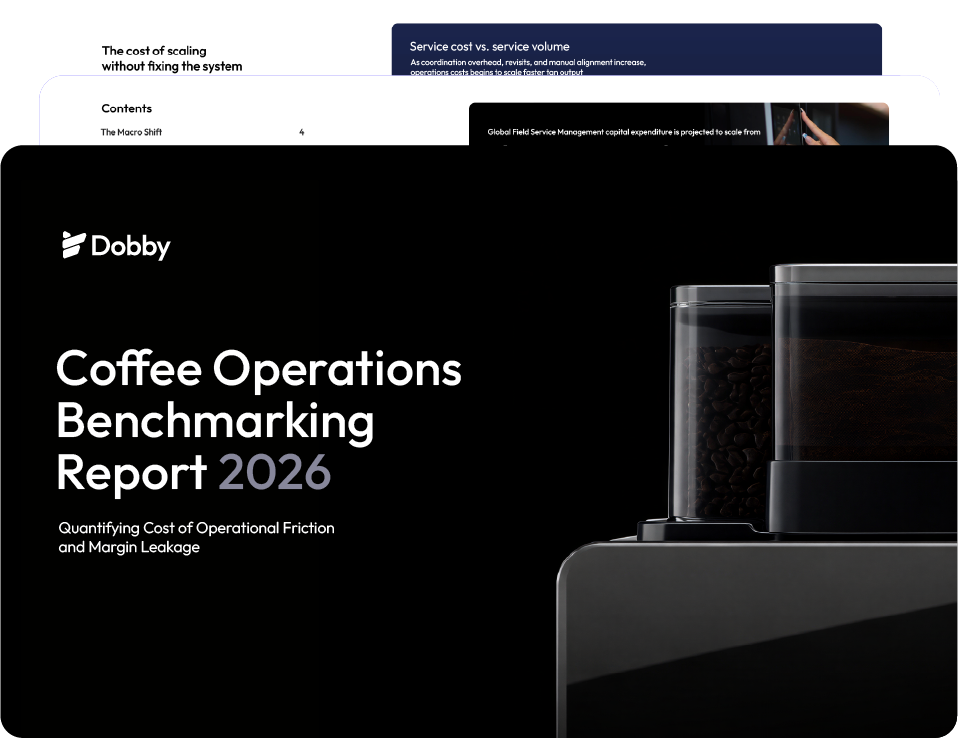
This article draws on findings from the 2026 Coffee Operations Benchmarking Report, focusing on the hidden costs of managing fleets with manual spreadsheets, real-time asset tracking gaps, and strategies to eliminate operational complexity.
For growing technical fleet operators, managing equipment across multiple customer locations often starts with a simple spreadsheet. At a small scale, it works: you log machine locations, track routine maintenance schedules, and manually record part numbers.
What begins as simple tracking turns into a complex Web of fragmented systems—CRM platforms for accounts, separate dispatches for field technicians, independent inventory tools, and manual spreadsheets filling in the gaps
The Hidden Cost of the "Excel Gap"
Operating across disconnected applications creates an implicit 20% to 30% coordination tax that quietly erodes profit margins. While point-solution tools may function well individually, the operational gaps between them force teams to rely on human labor as a manual integration layer.
This structural inefficiency doesn’t happen because technicians lack technical skill or mechanical experience. It happens because they lack localized context before they put the keys in the ignition.Minutes per day
20%
Capacity Drag
One-fifth of cumulative field team capacity is spent manually reconciling data and retrieving basic machine history.
20–30%
Re-dispatch Rate
Nearly a third of all service dispatches require a secondary visit, almost entirely due to missing real-time asset telemetry or part context before arrival.
When static spreadsheets and siloed software replace live asset visibility, field operations become reactive. Technicians arrive on-site without knowing the exact diagnostic state of the machine or whether the right component is in stock.
Why "Local Stability" Masks Systemic Margin Leakage
Your high-level KPIs might still look acceptable: SLAs are met, service visits are completed, and invoices are eventually sent. But this apparent stability is deceptive.
In fragmented operational environments, performance targets are sustained only because employees spend extra hours validating data, resolving scheduling conflicts, and fixing administrative errors behind the scenes.

Without a single source of truth, operational complexity scales non-linearly relative to revenue growth. A typical mid-scale fleet operator incurs approximately €585,000 annually in addressable operational complexity costs driven by coordination drag, repeat visits, and uncaptured parts usage.
Moving to a Unified Operating Standard
Transitioning past spreadsheets does not mean layering on another disconnected software tool. True visibility requires moving from task-based software to a Unified Operating Layer.
By anchoring field team activity, machine diagnostic telemetry, inventory tracking, and backend financial ledgers into a single synchronized core, fleet operators can unlock immediate efficiency gains:
Synchronous Asset Diagnostics: Technicians receive real-time fault telemetry and service histories prior to dispatch, lifting First-Time Fix Rates (FTFR) from the standard 68% benchmark up to 90%+.
Automated Inventory Ledgering: Component usage logged during a service visit automatically reconciles warehouse stock and syncs with billing, recovering up to 99%+ of parts billing accuracy and eliminating material leakage.
Faster Cash Velocity: Connecting field service completions directly to core ERP systems compresses manual data verification timelines from weeks down to seconds.
Managing a modern fleet via static spreadsheets and disconnected point solutions creates a growing competitive disadvantage. Operators who unify their core operational architecture eliminate the coordination tax, expand their field capacity, and turn asset visibility into a distinct competitive advantage.
Stop the Excel gap margin leakage
See How Real-Time Asset Visibility Eliminates Your €585k Coordination Drag