
Industry insights
Scalable Service: Building Architecture for Growth
11 Sep 2026

Written By Nikolaj Gaba
Share to
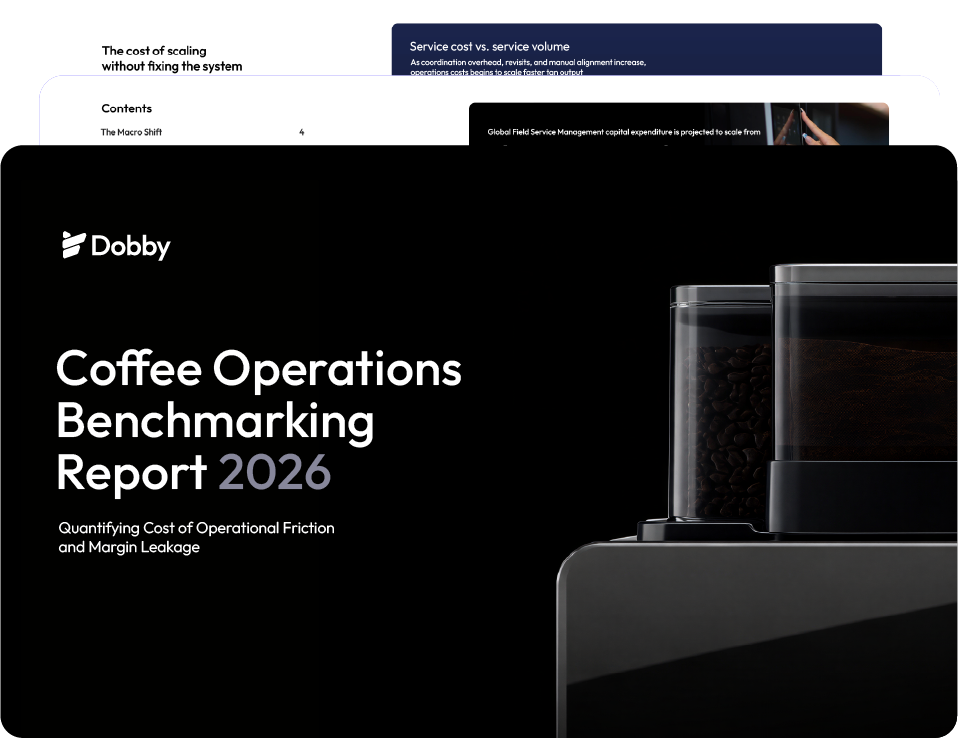
About the study
This article draws key data from the 2026 Coffee Operations Benchmarking Report, analyzing how tool sprawl, manual dispatch drag, and unbilled inventory impact fleet scalability and margin preservation.
For enterprise coffee fleet operators, expansion often comes with a frustrating paradox: as ticket volume grows, profit margins compress.
Adding more coffee machines, commercial accounts, and field technicians should drive linear revenue growth. Instead, it frequently introduces operational chaos—higher drive-time drag, delayed invoicing, missing inventory, and lower first-time fix rates.
This isn’t a team performance issue; it’s an architectural one. When fleet operations rely on fragmented legacy software, manual dispatching, and disconnected van stock, scaling doesn’t build enterprise value—it just scales friction. To grow profitably, operators must fix their internal infrastructure first.
The Hidden Cost of Fragmented Infrastructure
Most field service management tools were built for general trades—plumbers, HVAC, or electricians—not for specialized, high-volume commercial coffee machinery. To compensate, operators stack multiple point solutions together: one tool for messaging, another for ticketing, and a third for ERP billing.
This tool sprawl creates a heavy “coordination tax”:
Drive-Time & Dispatch Drag: Dispatchers spend hours manually mapping technician schedules, leading to inefficient routing and wasted fuel..
Revenue Leakage: Emergency component replacements and smaller fittings often fail to make it onto the final invoice.
Avoidable Re-Visits: Without instant asset context—like machine history, water filtration data, or specific model specs—technicians arrive unprepared, dragging down first-time fix rates
Attempting to scale an enterprise fleet on top of this leaky foundation only compounds these financial losses.
The Three Pillars of Scalable Operations
Architecting for growth requires transitioning from reactive maintenance to an automated service lifecycle where every job runs itself. High-growth operators build their service model around three core pillars:
1. Automated Dispatch & Intelligent Routing
Manual dispatching quickly becomes a major bottleneck as fleet size increases. Modern service architecture leverages intelligent routing to auto-assign tickets based on technician location, skill set, and job priority. By cutting drive-time drag, operators can unlock additional field capacity—adding up to a full extra job per technician every single day.
2. Closed-Loop Inventory & Real-Time Billing
Scaling seamlessly requires linking field work directly to financial reporting. When a technician uses a descaling kit or replaces a group head, that part should instantly deduct from van inventory and sync directly with back-office ERP billing. Closing the loop in real time eliminates unbilled parts and protects operating margins.
3. A Single Operating Standard
Eliminate 2–3x tool sprawl by consolidating field workflows into one unified platform. Giving technicians, dispatchers, and management a single source of truth ensures strict SLA compliance, complete asset visibility, and consistent service delivery across every location.
Architect for Profitability, Not Just Size
True scalability isn’t about hiring more back-office coordinators to handle administrative chaos—it’s about building an operational engine that handles volume effortlessly. By automating routine dispatch, unifying inventory, and connecting the field directly to finance, fleet leaders can expand their footprint while protecting their bottom line.
Protect your scaling margin
See the Operational Bottlenecks Flattening Your Fleet's Margin